A bad hair day is survivable. A bad hair day on camera, preserved in high-resolution, is another thing entirely.
Photos don’t lie, and they don’t forgive. What feels perfectly fine in a mirror can read flat, messy, or unfinished the moment a lens captures it. The hair that looked full in your bathroom lighting suddenly looks limp against a seamless backdrop. The curls you spent forty minutes on have relaxed into something vaguely undefined by frame three.
Photoshoot hair is its own discipline.
It isn’t just about choosing a style you like. It’s about choosing a style that holds, reads clearly on camera, and works with your face, your outfit, and the specific kind of shoot you’re doing. That’s where most people get tripped up, and that’s exactly what we’re covering here.
What Makes a Hairstyle Good for a Photoshoot
The camera rewards certain qualities in a hairstyle that everyday life doesn’t necessarily prioritize.
Definition. Hair needs visible structure on camera. Styles that are soft in texture but clear in shape photograph the best.
Longevity. A photoshoot is not twenty minutes. A full session runs anywhere from two to six hours. Your hair needs to look the same in the final frame as it did in the first. That’s not something you can manage with a single coat of hairspray and good intentions.
Proportion. The camera compresses dimension. A style that feels voluminous in real life can photograph as flat. One that feels moderate can look enormous.
Compatibility with light. Shiny, smooth styles catch light beautifully. Heavily matte or dry-textured styles can look dull under studio lighting. Waves and curls create depth. Sleek styles create luminosity. Neither is superior. Both need to be chosen with intention.
These are the factors that separate a hairstyle that looks good in your camera roll from hairstyle ideas for photoshoot settings that professionals swear by.
Best Hairstyle Ideas for Photoshoots
The type of hairstyle you’ll choose can affect the result of your photoshoot. This is what you need to know.
Soft Waves
Soft waves are consistently the most versatile and camera-friendly style on this list. They add movement, warmth, and dimension without crossing into anything overdone. They frame the face without dominating it. Under studio lighting, the wave pattern creates natural depth that flat or overly smooth styles simply don’t have.
- Best for: portraits, branding shoots, lifestyle sessions, maternity photography
- Pairs well with: open necklines, strapless looks, editorial makeup
- Longevity tip: set on medium heat, cool completely before releasing, finish with a flexible-hold spray
Sleek Ponytail
The sleek ponytail is not a simple hairstyle. It is a precise one. Every strand has to be accounted for. The tension needs to be consistent. The finish needs to be smooth. When it’s done right, it photographs with a sharpness that almost no other style can match.
- Best for: professional headshots, corporate branding, editorial and fashion-forward shoots
- Pairs well with: structured collars, minimalist outfits, bold earrings
- Longevity tip: use a strong hold gel at the root and a finishing serum at the ponytail for all-day smoothness
Low Bun and Updo
An updo removes hair as a variable entirely. That sounds reductive, but it’s genuinely strategic. When the hair is up and secure, the photographer can focus on expression, posture, light, and composition without any of it being disrupted by a strand falling across the face mid-shot.
- Best for: corporate headshots, production shoots, fashion editorial, video content
- Pairs well with: statement earrings, high necklines, structured blazers
- Longevity tip: use bobby pins generously, finish with a firm-hold spray, carry a few extra pins on set
Half Up Half Down
Half up, half down is the compromise that actually works. It keeps the softness and movement of wearing hair down while opening up the face the way an updo does. For shoots that need warmth and polish in the same frame, this style delivers.
- Best for: maternity shoots, personal brand sessions, natural light photography
- Pairs well with: flowy fabrics, soft makeup, outdoor or studio settings
- Longevity tip: secure the upper section properly before adding texture to the lower half
Braids and Textured Styles
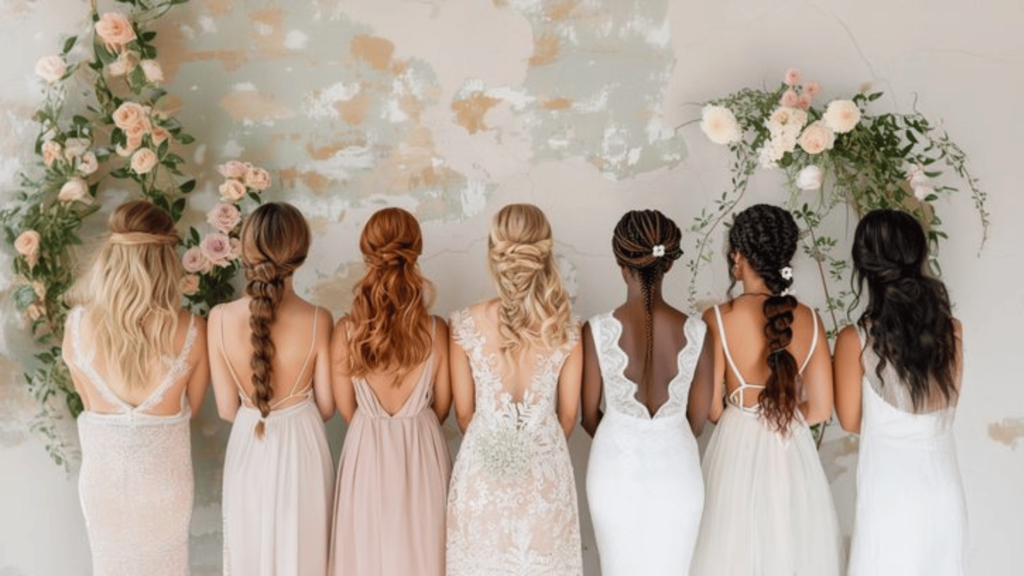
Braids are one of the most visually compelling hairstyle choices for photoshoots because they show up with incredible detail on camera. A loose braid, a French braid, a textured side braid, each one creates visual interest that plain down styles don’t. They also hold exceptionally well across a long session.
For branding photography specifically, a braid can communicate personality and creativity in a way that a standard blowout won’t.
- Best for: branding shoots, editorial sessions, lifestyle and outdoor photography
- Pairs well with: casual-cool outfits, natural makeup, textured fabrics
- Longevity tip: don’t braid too tightly. A slightly relaxed braid photographs more naturally and is more comfortable over time.
Hairstyles for Different Types of Photoshoots
Let’s give you all the tea you need to know
Branding Photoshoot
Hairstyle ideas for branding photoshoots need to communicate something specific. Your hair is part of your brand image in these shots. A polished sleek look positions you as precise and authoritative. Soft waves read as approachable and personable. A structured updo signals professionalism. A textured braid signals creativity.
None of these is objectively correct. The question is which one is correct for you and for what you’re building.
What matters most in a branding session is consistency. The style you choose needs to hold across dozens of frames in multiple setups. That means longevity isn’t optional.
Professional Headshots
Headshots are zoomed in. The camera is close. Every detail is visible. This is not the shoot to experiment with a new style you’ve never worn before, and it is not the moment to skip a professional.
For headshots, the hair needs to support the face without competing with it. Clean, defined styles perform best. A sleek blowout, defined curls, a smooth ponytail, or a polished low bun all work well. Avoid styles that add excessive volume at the sides, which can throw off proportions at close range.
Maternity Photoshoot
Maternity photography calls for softness. Loose waves, romantic half-up styles, and flowing textures all photograph beautifully in this context. The hair should feel natural and a little luminous, adding to the warmth of the image.
Comfort also matters here more than in most other shoot types. Hairstyle ideas for maternity photoshoot planning should factor in the physical reality of the session. A style that’s uncomfortable to hold for two hours becomes a distraction. Soft, flowing styles that require no constant adjustment are the practical choice.
Video and Production
Video adds complexity that still photography doesn’t have. Multiple camera angles, shifting lighting, and continuous movement all affect how hair performs on screen. A style that looks perfect in a still frame can read differently when it’s in motion or under a different angle.
On-camera hairstyles for video and production work need to be controlled without looking staged. This is where production hairstyling services are the clearest investment. A stylist who understands how hair reads on video, not just in a still photo, is doing fundamentally different work. That expertise is visible in the final cut.
Hair Down vs Updo for Photoshoots
This can get confusing fast, but it doesn’t need to be if you know exactly what will match your goal.
When Hair Down Looks Better
Hair down photographs with more personality. Waves, curls, and blowouts create dimension and movement that closed styles can’t replicate. For shoots where warmth, approachability, or a sense of ease is part of the visual story, wearing hair down almost always produces the stronger image.
Lifestyle sessions, editorial shoots, maternity photography, and personal branding sessions that lean candid all benefit from the openness of hair down.
When Updos Work Better
Updos become the right answer when precision and longevity matter more than movement. Corporate headshots, productions, longer shoot days, and warmer shooting environments all call for an updo. There’s nothing to manage, nothing to adjust, nothing that shifts between shots.
For shoots with multiple outfits or setups, an updo also provides visual consistency that makes the final gallery feel cohesive rather than chaotic.
How to Choose Based on Face Shape and Outfit
Face shape is the often-skipped part of this conversation.
- Oval faces photograph well with almost any style.
- Round faces benefit from height and vertical lines. A high ponytail or updo with volume at the crown creates length.
- Longer faces balance best with volume at the sides. Waves and curls at mid-length work well.
- Square faces soften with loose waves or styles that don’t emphasize the jaw.
Outfit matters equally. A detailed neckline or statement collar needs the neck clear. An updo or ponytail serves that. A simple or open neckline benefits from hair that fills the frame with texture and movement.
How to Prepare Your Hair for a Photoshoot
There’s nothing more rewarding than knowing what and how to prep before a shoot.
Hair Prep Before the Shoot
Most stylists will tell you the same thing: don’t wash your hair the morning of the shoot. Freshly washed hair is often too smooth and soft to hold style reliably. Second-day hair has natural texture and grip that makes it easier to work with and easier to keep in place across a long session.
The night before, wash and condition your hair. Let it dry naturally. Come to the shoot with clean but not brand-new hair, and let the stylist work from there.
Products That Help Hair Last
The products layered underneath the finished style are what determine how long it lasts.
- Heat protectant before any tool touches the hair
- Texturizing or hold spray as a base layer for styles that need grip
- Firm-hold spray to lock the finished style in place
- Finishing serum or oil on the surface for shine and frizz control without heaviness
High-quality products are non-negotiable for camera work. Cheap hold sprays go stiff and visible. Cheap serums go greasy under lighting. The camera picks up both.
Hair and Makeup for Photoshoot Planning
Hair and makeup planned together produce a better result than either planned separately. The way the makeup is finished affects how the hair reads in the frame. The placement of the hair affects how the makeup is visible and how the face is framed.
When these two are coordinated by a single team with a clear visual goal, the images look cohesive. When they’re done independently, even a stunning makeup look and a beautiful hairstyle can end up working against each other in the photo.
So, Should You Hire a Hairstylist for a Photoshoot?
For any shoot that has a professional purpose, yes. And the answer doesn’t change based on how capable you are at doing your own hair at home.
A professional hairstylist who works shoots understands camera-ready finishes, longevity under lights, and how to build a style that holds for hours without needing constant attention. That’s a specific skill set, and it shows in the images.
Our mobile hairstylist for photoshoot services starts at $110 and comes directly to you. No salon trip, no arriving to set already exhausted from getting ready across town. Our artists come equipped for both still photography and on-camera video production, making them the right call for any type of shoot.
We currently serve Las Vegas, Atlanta, Miami, New York, San Francisco, Nashville, Los Angeles, Orange County, San Diego, Hawaii, and Cleveland.
Book your hair photoshoot appointment today.
FAQs About Photoshoot Hairstyles
What hairstyle is best for a photoshoot?
There’s no single correct answer, but the most reliable hairstyle ideas for photoshoot sessions are soft waves, sleek ponytails, and structured updos. All three photograph clearly, hold well over time, and work across different lighting setups.
Should I wear my hair up or down for photos?
Hair down creates softness, movement, and personality. Updos create structure, precision, and consistency. For headshots and productions, up is typically the stronger choice. For lifestyle, maternity, and personal brand work, down usually reads better.
How do you make hair look good on camera?
Start with a defined, intentional style. Control frizz and flyaways. Use products that hold without going stiff. Build the style to last for hours, not minutes. Work with a professional who understands how hair translates on camera specifically, because that’s different from everyday styling.
Do I need a hairstylist for a photoshoot?
For professional or commercial work, yes. A stylist who understands production and photography brings precision and longevity that self-styling can’t reliably achieve on a shoot day. Our mobile service removes the logistical friction. We come to you, fully equipped, so you arrive to your shoot ready.
Share
Related posts